


Classic Bronco Parts That Make a Vintage Bronco Worth More
At Krawlers Edge we build long-lasting classic Bronco parts for the early Ford Bronco, the legendary off-roaders built from 1966 to 1977. Here are five upgrades that make an old Bronco drive better, last longer and sell for more.

Vintage Bronco Parts From People Who Love Early Broncos
We understand your love for these iconic trucks because we love them too. Our Ford Bronco parts are built so your classic Bronco doesn’t just hold up, it gets better.
Early Broncos are all we work on. Years of it have taught us where these trucks wear out and fail, and we build our parts around those weak spots.
We’re not just mechanics and technicians. We’re Bronco people who put everything into each Bronco we work on and each part we build, and it shows in the details.

5 Ways to Upgrade Your Vintage Bronco and Increase Its Value
Your Ford Bronco isn’t just a vintage treasure. It’s an investment.
The right classic Bronco parts improve how your Bronco drives and what it’s worth, and it still keeps the classic look. Here are five ways to do it.
1. Make It Go Faster With a Modern Engine Swap
Our Coyote engine and 2.8 Cummins Turbo Diesel swaps are a big performance upgrade. It’s one of the first places people look when they want to restore or modify an aging Bronco.
A modern engine adds power, fuel economy and reliability, which makes your Bronco more appealing to buyers. A classic Bronco with a modern powertrain can bring a lot more money.
Thinking about a new engine for your Bronco? We’ll walk you through the process and make sure you have every part the swap needs, starting with our early Bronco Coyote swap parts.

2. Make It Drive Better With a New Frame or Rolling Chassis
A new frame or rolling chassis from our partners at Kincer Chassis adds years to your Bronco and improves the suspension and handling. Buyers notice that extra safety and control, so it adds resale value too.
The extra power of a modern engine has to be tamed, and that takes a modern chassis and suspension.
A bone stock early Bronco actually runs and drives pretty well. The problem is very few Broncos are stock after 50+ years. Add a lift kit, more power and bigger tires, and your suspension angles get out of whack.
A Kincer chassis corrects that. The suspension link and steering geometry are set up for a good ride and steering feel, like a modern vehicle. See the early Bronco chassis.

3. Make It More Practical With an Early Bronco Sport Cage
Our early Bronco roll cage is built from 1.75” x .120 wall tubing. It fits hard tops, soft tops and bikini tops, and the top bows still retract without hitting the cage. If you don’t have a top yet, our custom bimini top is made for this cage.
It installs from inside the Bronco and has threaded bungs welded in for 3-point seat belts at all four seats. We can include the seat belts with your order.
It gives your Bronco a sporty look that stays true to the rugged Bronco image, and that modern safety makes it more desirable when it’s time to sell.

4. Make It Last Longer With Regular Maintenance
Keeping as much of the original Bronco as you can, along with regular maintenance, is key to holding and growing its value.
Keep the bodywork in good shape, take care of the interior and hold on to the original features. Buyers pay more for all of it.
If your Bronco lives outside, keep it covered when you’re not driving it. It makes a real difference.

5. Make It Worth More With High-Quality Classic Bronco Parts
Use authentic, high-quality parts for every repair or replacement. Our parts match the quality of your Bronco and keep it close to original while adding the improvements it needs.
Take our 23 gallon stainless steel early Bronco fuel tank. It holds nearly double the stock tank and it’s ready for EFI.
Parts like that make your Bronco better on the road and protect what it’s worth.

You Might Just Keep It
With these upgrades you’re not only enjoying your Bronco more. You’re adding to its value, so if you ever sell, the offers will roll in. You might decide to keep it anyway.
We hear it from people all the time: they sold their Bronco and regretted it. No price was worth losing the memories they made in it.
Classic Bronco Parts We Build
Chassis, sport cages, fuel tanks and Coyote swap parts for 1966-1977 Broncos, built in Louisville, Tennessee. See the full list of our early Bronco parts, and if you don’t see what you need, ask. We make more than what’s on the site.

Early Bronco Chassis
CNC mandrel bent 2x4 frame rails from Kincer Chassis. It bolts to your factory body and gives you 2” more room between the rails for a Coyote.
Frames from $3,999.99
See the chassis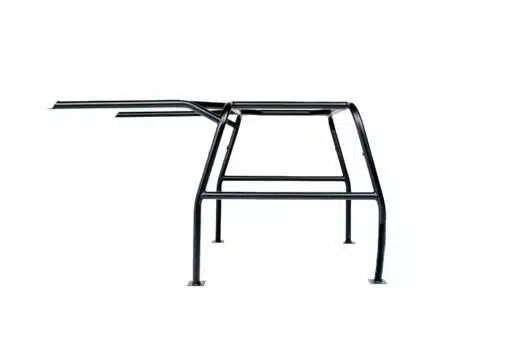
Early Bronco Sport Cage
A fully welded family sport cage with threaded mounts for 3-point seat belts built in. CNC bent, laser notched and built in Tennessee.
From $1,250
See the roll cage
Coyote Swap Parts
Motor mounts, headers, radiator, exhaust, front drive kit and tilt column, made to work together in an early Bronco.
Parts from $355
See the Coyote parts
Stainless 23 Gallon Fuel Tank
A 304 stainless steel EFI tank that holds nearly double the fuel of the original, ready for a fuel-injected Coyote.
$1,595
See the fuel tankClassic Bronco Questions and Answers
Early Bronco owners have a lot of questions, and good answers are hard to find. Forums argue, listings stretch the truth, and a lot of what’s online is somebody’s best guess.
The Kincer family of companies, Krawlers Edge, Kincer Chassis and Kincer Garage, builds early Broncos all day, every day. Here are straight answers to what we hear most.
If you’re serious about a build or a purchase, talk to someone who does this for a living.
How much is a vintage Bronco worth?
It depends on condition, originality and the build. Hagerty put the average first-gen Bronco in excellent (#2) condition at $53,700 in summer 2026. That’s down about 14% and back to roughly where values were in 2019.
Asking prices run much wider. Projects and driver-quality trucks sell for well under that, and fully built restomods with modern drivetrains are listed anywhere from about $65,000 to $300,000.
Buying or selling one? Call (865) 297-3478 and we’ll tell you what we’d look at before you settle on a price.
How much is a 1974 Ford Bronco worth?
A 1974 sells in the same range as other 1970s wagons in the same shape. The year matters less than rust, originality and the quality of any work that’s been done.
A rusty project can go for a few thousand dollars. A clean, well-built truck brings many times that.
Send us photos and we’ll give you an honest read: email info@krawlersedge.com.
What is the best year for a vintage Bronco?
It depends on what you want from it. Collectors chase 1966 to 1968, especially the Roadster and uncut original trucks.
For a driver, the later years bring more. The stronger Dana 44 front axle arrived in mid-1971, the C4 automatic and factory power steering became options in 1973, and front disc brakes were standard from 1976.
If you’re planning a Coyote swap and a new chassis, the year matters much less. The drivetrain, suspension and brakes are all getting replaced anyway.
What year of Bronco should you stay away from?
There isn’t a bad year. What to stay away from is rust and bad work.
Early Broncos rust in the rockers, floors, cargo floor, door hinge areas, firewall and cowl. Check the frame too, and look hard at anything that’s been cut, patched or heavily modified.
A solid body on a bad frame can still be a good buy, because a new Kincer frame bolts to the factory body. Before you buy, email info@krawlersedge.com with photos and we’ll tell you what we see.
Why is the 1974 Bronco so popular?
Mostly because there are more of them. Ford built 25,824 Broncos in 1974, more than in any year before it.
It also has the options people want in a driver: the 302 V8, the C4 automatic and power steering, all available from 1973. More trucks means more come up for sale, and more people looking for 1974 Bronco parts.
What is the rarest early Bronco?
The Roadster is the rarest body style. Ford built about 4,090 in 1966 and dropped it after 1968.
The Baja Bronco is rarer still. About 650 were built between 1971 and 1975.
How much did an early Bronco cost new?
In 1966, the base Ford Bronco sold for about $2,194. Today, well-kept early Broncos are rare and bring many times that.
How many Ford Broncos were made in 1966?
Ford built about 23,776 Broncos in 1966, the first year of production: 12,756 Wagons, 6,930 Sport Utilities (the half-cab pickup) and 4,090 Roadsters.
They were Ford’s answer to the Jeep CJ and the International Harvester Scout.
Which years do these classic Bronco parts fit?
Our parts are built for first generation Ford Broncos: 1966, 1967, 1968, 1969, 1970, 1971, 1972, 1973, 1974, 1975, 1976 and 1977.
A few parts have their own fit notes, so tell us your Bronco’s year when you ask for pricing.
What engines came in the early Bronco?
Early Broncos came with a straight six (the 170, then the 200 from 1973) or a small block Ford V8 (the 289, then the 302 from 1969).
At Krawlers Edge we build for more modern power: the 5.0 Coyote, the 2.8 Cummins Turbo Diesel and the 2.3 EcoBoost, which is a good balance of power, economy and cost.
What transmissions came in the early Bronco?
When the Bronco came out in 1966, it had a three-speed manual shifted from the steering column, the “three on the tree” that was common at the time.
In 1973 Ford added the C4 automatic, a three-speed known for being durable and simple.
When did early Broncos get power steering and disc brakes?
Factory power steering became an option in 1973. Front disc brakes became standard in 1976, when power brakes were offered as an option too. Earlier trucks have drum brakes all around.
A Kincer rolling chassis comes with Wilwood disc brakes, so the year of your truck stops mattering. See the early Bronco chassis.
How can I tell what engine my early Bronco has?
Start with the VIN. The fourth character is the engine code, and on these trucks the VIN is stamped on the frame rail below the engine, ahead of the firewall.
Keep in mind a lot of early Broncos have had engines swapped since they left the factory, so the VIN tells you what it came with, not always what’s in it now.
Not sure what you’re looking at? Email info@krawlersedge.com with photos of the VIN and the engine and we’ll help you sort it out.
What is the best engine swap for an early Bronco?
The 5.0 Coyote is the most popular modern swap, and it’s what most of our swap parts are built around. Kincer chassis are also set up for the 3.5 EcoBoost, the 351W, the Cummins R2.8 turbo diesel and the 4BT.
Our sister company Kincer Garage sells crate engines, including the Coyote, the Godzilla and EcoBoost options.
The best choice depends on how you drive, what you want to spend and what’s in the truck now. Call (865) 297-3478 and talk it through before you buy an engine.
Can I do a Coyote swap on my factory frame?
Yes. Our CNC Coyote motor mounts and tilt steering column fit a factory frame or a Kincer chassis.
A Kincer frame is 2” wider between the rails than stock, which leaves more room for the Coyote and its front drive accessories. Either way, plan on at least a 1” body lift. We recommend 2”.
See everything that goes into the swap on our early Bronco Coyote swap parts page.
What steering column works with a Coyote swap?
Our kit is built for Coyote-swapped early Broncos and clears the valve covers. It uses a Flaming River tilt column with a firewall plate, boot, adjustable column clamp and a collapsible shaft with u-joints matched to your steering box.
It fits a factory frame or a Kincer chassis: $1,595 for floor shift, $1,795 for column shift. See the early Bronco tilt steering column.
Do I need a new frame for my early Bronco?
You do if yours is rusted through, cracked, bent or cut up, or if you’re adding a lot of power and bigger tires.
The factory frame has two cross members. A Kincer frame has four, is built from 2x4 tubing with a 3/16” wall, and bolts to your factory body in the stock mount locations. Frames start at $3,999.99.
How big a tire can I fit on an early Bronco?
There isn’t one answer. It comes down to your lift, whether the fenders are trimmed or flared, wheel backspacing and axle gearing.
Bigger tires usually mean flares and new gears, and the right combination is different on every truck. Call (865) 297-3478 with your setup and the tire you want, and we’ll tell you what it takes.
Do you ship parts?
Yes. For a shipping quote, send us your address, whether it’s a home or a business, and whether you have a forklift or need a liftgate truck.
You can also pick up at our shop in Louisville, Tennessee.
Get Pricing on Classic Bronco Parts
In the message box, tell us your Bronco’s year and which upgrade you’re planning (Coyote swap, chassis, sport cage, fuel tank) so we can get you the right pricing. Rather talk now? Call (865) 297-3478.